Practical suggestions educators for incorporating sustainability education in their teaching.
Four simple ways to teach children to be sustainable include:
1. Read storybooks with environmental themes
Reading storybooks with your child is both an opportunity to bond with them, and an excellent way to introduce difficult topics such as climate change in a child-friendly way. ABC Kids recommends some well-known classics such as Where the Wild Things Are and Charlotte’s Web to start the conversation about the importance of living sustainably.
2. Discuss sustainability at home
Engage your child in discussions about being sustainable at home, such as noticing how the rubbish bin is full, or how many food scraps are left over after dinner, or when the tap hasn’t been turned off correctly. Discuss what can be done to reduce waste, such as recycling rubbish or composting food scraps. You may even like to start a worm farm or compost bin at home or involve your child in sorting through rubbish together to see what can be recycled or re-purposed. For preschoolers, having a responsibility or job to do can help scaffold their growing independence while also forming sustainable habits. Give your child the job of being the “energy saver” in the house, responsible for noticing lights, fans and other appliances left on when not in use.
3. Spend more time in nature
When was the last time you got outdoors as a family? Going on bushwalks, visiting the beach, birdwatching or simply enjoying the nature in your own neighborhood provide many important opportunities to discuss sustainability. As you’re walking or enjoying the scenery, discuss the environment around you, observe any animals you see along the way, or you could even bring a bag to collect some rubbish on your walk and discuss how it’s important to keep our environment clean.
4. Start a veggie garden
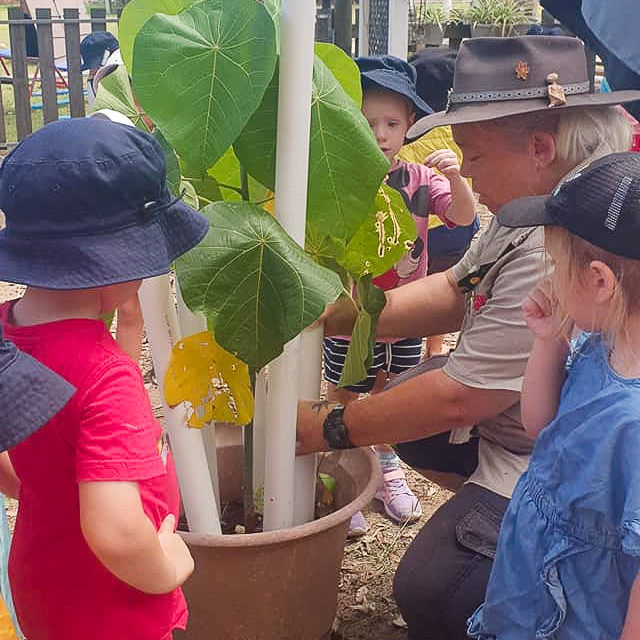
Perhaps you could start a veggie patch at home. Planting seeds, watering and caring for plants helps children understand the concept of food and where it comes from. Through growing their own vegetables, children learn about the process of farm to plate. This also opens up so many potential conversations around food production and climate change: How long do you think this zucchini will take to grow big enough to eat? What would happen if there was not enough rain to water the garden?
- Including sustainability and environmentally responsible practices as part of the curriculum, and in discussions with children and families
- Providing information to families on environmentally responsible practices that are implemented at the Service and encouraging these practices at home.
- Making recycling part of everyday practice at the Service – Recyclable containers will be provided throughout mealtimes and in learning experiences.
- Sharing ideas between Educators, children, and families about environmentally responsible ideas, implementation, and resources. This will be supported through our communication strategies, including parent meetings, emails, newsletters, and informal conversations.
- Role modelling energy and water conservation practices: For example, turning off lights and air-conditioning when a room is not in use, emptying water play containers onto garden areas.
- Embedding the concept of ‘reduce, re-use and recycle’ in everyday practice for both children and Educators to build lifelong attitudes towards environmentally responsible practices.
- Purchasing equipment that is environmentally friendly where possible. Educators will reduce the amount of plastic and disposable equipment they purchase and select materials that are made of natural materials.
- Using worm farms and/or compost bins to reduce food waste in the Service. Children will be encouraged to place food scraps into separate containers for use in the worm farm or composting bin. Educators will provide visual guides and discuss with the children and families which scraps worms can eat, which foods can be composted, and which food scraps must go in the bin. The children will be involved in maintaining the worm farm and compost bin.
- Using ‘green cleaning’ products to replace chemicals where possible.


Comments
Post a Comment