Positive impact on students' engagement and environmental stewardships.
Environmental stewardship refers to the responsible use and protection of the natural environment through active participation in conservation efforts and sustainable practices by individuals, small.
Environmental stewardship conserves natural resources, combats pollution, and protects biodiversity, but most importantly, it means we protect and sustain our environment for future generations.
Greener environments may foster learning because they are calmer and quieter, because they foster warmer relationships, and because the combination of “loose parts” and relative autonomy elicits particularly beneficial forms of play.
In a world where it is increasingly challenging to get students interested in classroom lessons, environmental education offers an enriching way for both students and teachers to connect their appreciation of the natural world to academics.
In a study examining how outdoor learning influences the satisfaction of basic psychological needs, researchers collected data relating to a week of learning in two educational settings: a regular classroom and a residential outdoor learning course. These two settings incorporated social learning, personal development, and ecological knowledge in a regional context, as students worked in groups to learn about various science topics. Students completed questionnaires in each educational setting to evaluate the effect that each had. Additionally, researchers held group-interviews that provide insight into students’ attitudes and beliefs.
Data analyses show that basic needs satisfaction in the outdoor context is higher than indoors and more significantly, the outdoor program had the biggest increase in the students’ intrinsic motivation. When students have higher intrinsic motivation, their behavior is driven by internal rewards, rather than extrinsic rewards, such as bad grades. Thus, learning is more naturally satisfying, and students are more engaged.1
Supporting research also asserts that environmental education and outdoor programs utilizing explorative learning can drastically improve the student’s learning attitudes. Additionally, when these outdoor learning experiences are implemented by trained teachers in familiar settings, students are more engaged and experience greater science achievement.2
A 2003 study illustrated the effect of structuring curriculum to meet state standards while organizing activities and multidisciplinary teaching units around environmental themes since children have a natural interest in the environment around them. Interested students are motivated students, and motivation is a key ingredient for academic achievement. In the study, students at these schools were more enthusiastic about learning and performed better academically. Teachers were also more enthusiastic about teaching—they brought more innovative instructional strategies into the classroom and took more leadership in school change.3
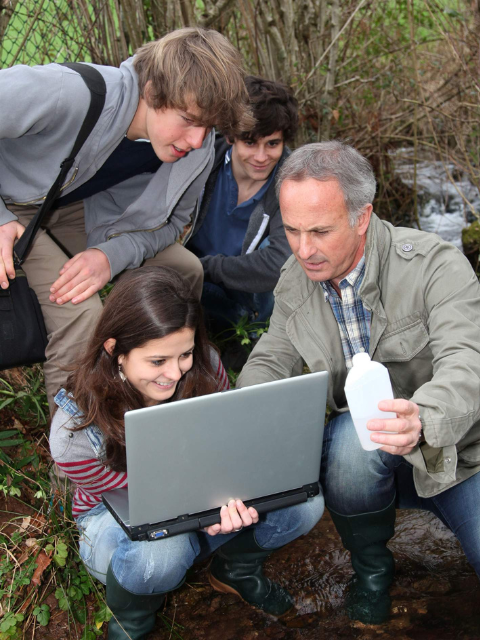
Environmental education and outdoor programs utilizing explorative learning can drastically improve the student’s learning attitudes.
Develops confidence to investigate and solve local problems.
Environment-based education emphasizes specific critical thinking skills central to “good science”—questioning, investigating, forming hypotheses, interpreting data, analyzing, developing conclusions, and solving problems. High school students in an intensive, urban ecology focused summer program conducted scientific investigations of their urban ecosystems using geographic information systems (GIS) and computer modelling. Through these tools, students are learning about the ecological services provided by the urban forest canopy and about the impact of urban noise on birdsong.
By tackling real-world projects as opposed to merely doing workbook exercises, students improve their science self-efficacy. Through conducting pre and post surveys of students on their beliefs and experiences during this study, researchers found that by engaging students in local and focused targeted environmental science investigations, students developed the confidence to investigate and solve local problems that increased their ability to study science.4
In the 21st century, the use of technology is increasingly essential for everyday life. By using technology to teach environmental education concepts, educators impart to set students a valuable life skill. One study observed the effects of using digital technology during outdoor education experience. Project EARPOD (Engaging At-Risk Populations Outdoors, Digitally) used an integrated technology program to engage underserved students in environmental education while also examining the effectiveness of incorporating technology into their educational experience. Results showed that students reported an increase in using technology outdoors, gained knowledge of available technologies, and expanded their knowledge of different technologies. This increase in technology-specific knowledge leads to an in
Fosters interest in STEM careers
As the world becomes increasingly interconnected and complex, the youth need to be equipped with the skills and knowledge to investigate and solve problems. Since those in STEM careers are often tasked with figuring out solutions to the world’s problems, students must be introduced to these skills and begin learning about careers in STEM from a young age. In 2014, an experimental study examined the impact of a citizen science program on middle school students’ science performance and STEM career motivation. Students conducted fieldwork with naturalists and collected data related to horseshow crabs that would be used for professional biologists. The results supported hypotheses that students would report higher motivational beliefs regarding science and show higher levels of achievement. Further, analyses showed that these motivational beliefs influence content knowledge and outcome expectations, which then influence career goals.6
Enhances creativity.
Environmental education courses typically -expect- results such as positive impacts on students’ environmental attitudes, beliefs, and knowledge. Due to the nature of program design, courses can also develop other skills in students. In a project-based learning EE course where students developed projects to solve environmental problems, students were found to not only have increased positive environmental attitudes but also enhanced creativity. When working together to collaborate and seek unique solutions to problems, they were able to hone into their creativity and take on more active tasks in the solution process.7
Incorporating aspects of environmental education into STEM topics can help illustrate the power of EE. It can also be combined with art instruction to deepen understanding of both areas. A paper examining the crossroads of public art, nature, and environmental education states that the benefits are:
- Promotes intellectual development.
- Encourages inspiration.
- Supports consciousness about social and environmental issues.
- Develops a sense of connection with nature.
- Teaches how to ask questions and examine contextual information.

Comments
Post a Comment